Clearing Land With a Mini Skid Steer: Which Attachment Does Which Job
A mini skid steer can clear a surprising amount of ground, but not with one attachment. Land clearing on a mini breaks into four jobs that happen in order: cut what’s standing, move what you cut, handle the logs, then deal with the stumps. Each job takes a different tool, and knowing the order tells you which one to buy first.
It also helps to know where a mini runs out of room. That’s covered further down.
What a Mini Skid Steer Can Realistically Clear
Most stand-on mini skid steers run somewhere around 10 to 20 gallons per minute of auxiliary hydraulic flow and lift a fraction of what a full-size machine can. That sets the ceiling. A mini is at its best on overgrown lots, fence lines, trails, and brush and saplings up to about 4 inches in diameter.
What you get in return is access. A mini fits through a backyard gate and turns in tight spaces between trees. On tracks, it’s also light enough to work on a lawn without tearing it apart.
Job 1: Cut What’s Standing
Everything starts with a brush cutter, which a lot of owners call a brush hog. You can’t grab or haul brush that’s still rooted, and cutting first shows you what’s actually on the ground: hidden stumps, rocks, washouts and old fence wire.
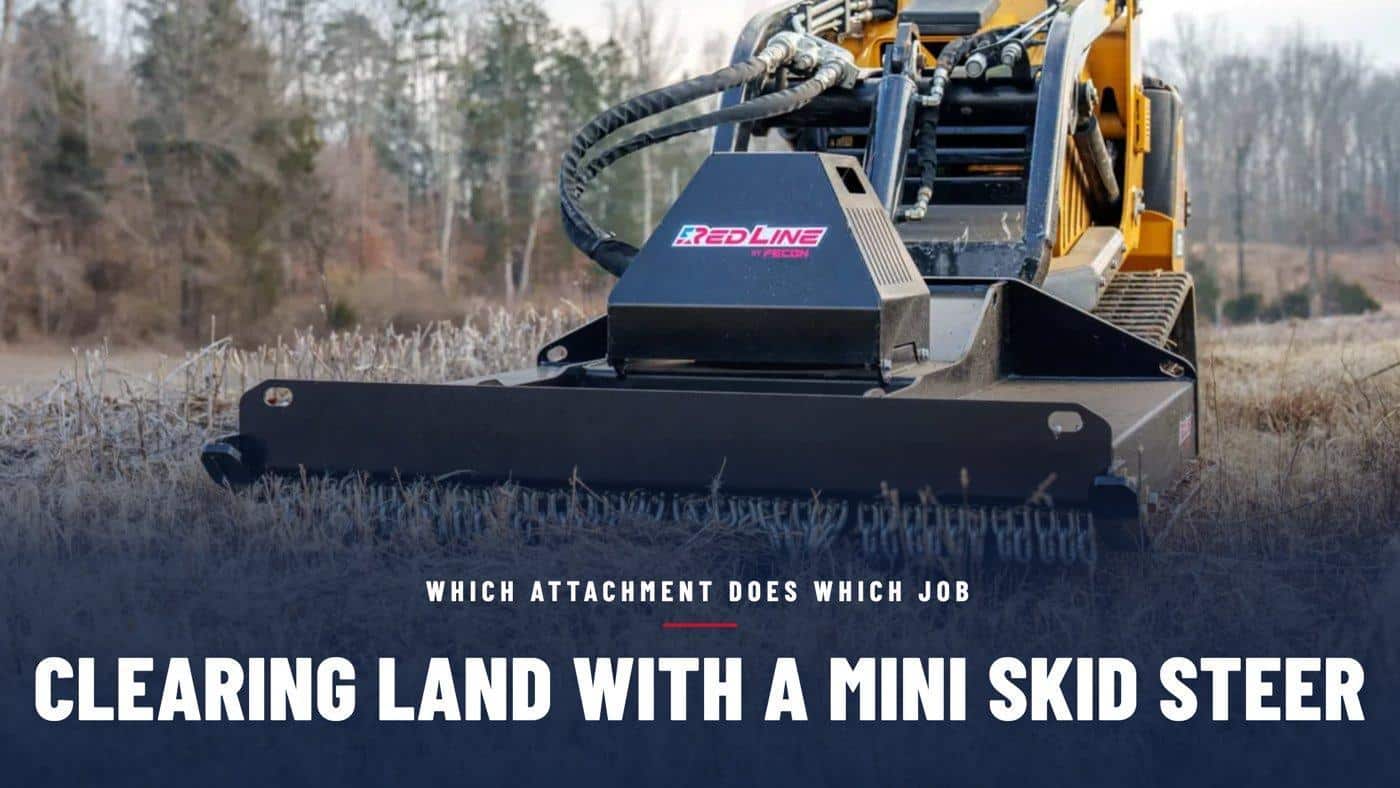
The Red Line 42-inch brush cutter built for mini skid steer hydraulic flow runs on 10 to 20 GPM and cuts brush and saplings up to 4 inches in diameter. Its hoses are shielded, and a direct access design makes blade service quicker. The BC42 in the photo at the top of this page runs a chain curtain across the front, which helps keep thrown material down.
Two things to watch. Saplings cut by a rotary cutter leave stiff, sharp stubs that can puncture tires, so cut as low as you safely can or run a tracked machine. And at 780 lbs, the BC42 is the heaviest attachment in this article, so check it against your mini’s rated operating capacity before you buy.
Job 2: Move What You Cut
Once it’s down, cut brush has to go somewhere, whether that’s a burn pile or a dump trailer. The Red Line 48-inch brush grapple with two independent lids for mini skid steers weighs 350 lbs and works like an open-bottom bucket with clamping lids. You can push brush together into a pile and scoop it up, and the open tines let dirt and rocks fall through instead of riding along to the burn pile or chipper.
The two lids clamp independently, so a load with a thick limb on one side and loose brush on the other stays locked in. That matters on cleared ground, where nothing you pick up is uniform.
Job 3: Handle the Logs
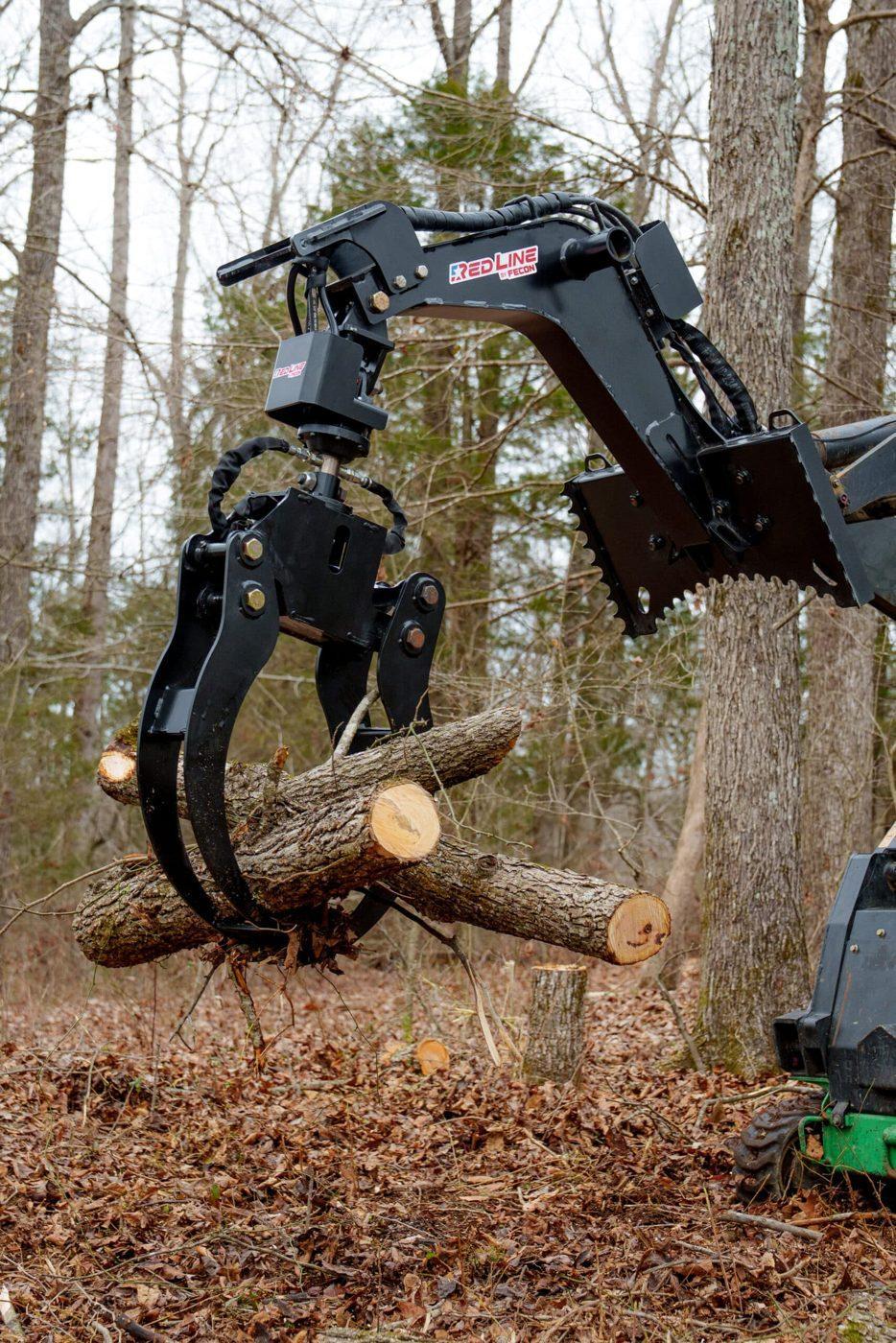
If the lot has trees worth taking down, the trunks need handling that a brush grapple does poorly. The Red Line rotating log grapple with rope bollards for mini skid steers hangs from a rotator and closes around round wood from above, so you can pick a log at its balance point and set it square on a trailer without repositioning the machine. It weighs 375 lbs and comes with free-swing rotation standard, with hydraulic or electric-over-hydraulic rotation as options.
For tree work, the rope bollards let the machine anchor a rigging line, and the push bar helps steer a stem as it comes down. For a closer look at how a log grapple and a brush grapple split the work, we’ve compared the two side by side.
Job 4: Deal With the Stumps
Stumps come last, and they don’t always need to go. In woods or pasture, a stump cut close to the ground can often stay. If the ground is going to be mowed regularly or graded for building, it has to come out.
Fecon makes stump grinders that run on mini skid steer flow, including the Stumper carbide-wheel stump grinder for mini skid steers and the auger-style Compact STUMPEX that grinds down into the stump. They’re part of Fecon’s stump grinder line rather than Red Line, so ask your dealer which model fits your machine.
The Four Jobs at a Glance
| Job | Attachment | Handles | Weight |
|---|---|---|---|
| Cut standing brush | Red Line BC42 brush cutter | Brush and saplings up to 4 in | 780 lbs |
| Move cut brush | Red Line BG48 brush grapple | Loose brush and debris | 350 lbs |
| Handle logs | Red Line LG57 log grapple | Logs and timber, 57 in opening | 375 lbs |
| Grind stumps | Fecon Stumper or Compact STUMPEX | Stumps and roots | Varies by model |
Which to Buy First
For most overgrown ground, buy the brush cutter first. Without it, nothing else has anything to do. Add the brush grapple once cut material starts piling up faster than you can move it by hand. The log grapple earns its place on lots with real trees, and stump grinding comes last, often only in the areas you plan to mow or build on.
If the job is storm cleanup rather than overgrowth, flip the order. The brush is already down, and the grapple is the first tool you need.
Where a Mini Runs Out
Past about 4 inches of material, or once the job is measured in acres rather than lots, a mini starts losing time. Low hydraulic flow limits what a cutter can process, and a small machine moves a small load per trip.
Forestry mulching is the clearest example. A mulcher grinds standing trees and brush into mulch in one pass, but it needs more flow than most minis make. Fecon’s standard flow Bull Hog mulcher for skid steers starts at 17 GPM and mulches trees up to 5 inches, but it’s built for full-size skid steers and compact track loaders. For cutting without mulching, the full-size Red Line brush cutter that handles material up to 6 inches comes in 60 and 74-inch models.
Plenty of owners run a mini for the tight work around buildings and fence lines and bring in a full-size machine for the open ground.
Before You Buy
Check your mini’s auxiliary flow, because every attachment here has a range it needs to run properly. Check its rated operating capacity against the attachment’s weight, since a 780 lb brush cutter on a small machine leaves little margin. Confirm the mounting plate, because mini skid steers use a different quick attach than full-size machines. And measure your gate. Send us your make and model and we’ll confirm the fit.
Working Safely on a Stand-On Mini
A stand-on mini puts the operator outside, with no cab between them and the attachment. A brush cutter can throw sticks and rocks a long way, so keep people well back while it’s running and wear eye and hearing protection. When handling logs, keep loads low while you travel. A log carried high on a small machine raises its center of gravity fast, and minis tip more easily than their size suggests.
Frequently Asked Questions
Q1. Can a mini skid steer clear land?
Q2. Can you run a forestry mulcher on a mini skid steer?
Q3. How big a tree can a mini skid steer brush cutter cut?
Q4. What hydraulic flow do mini skid steer attachments need?
Getting Set Up
Start with the job in front of you. Standing overgrowth needs a brush cutter, and brush that’s already down needs a grapple. The brush cutter and both grapples are part of the Red Line attachment line, backed by Fecon’s 12-month, 1,000-hour warranty. Send us your mini’s make and model and we’ll confirm the fit.