Log Grapple vs Brush Grapple: Which One Fits the Job
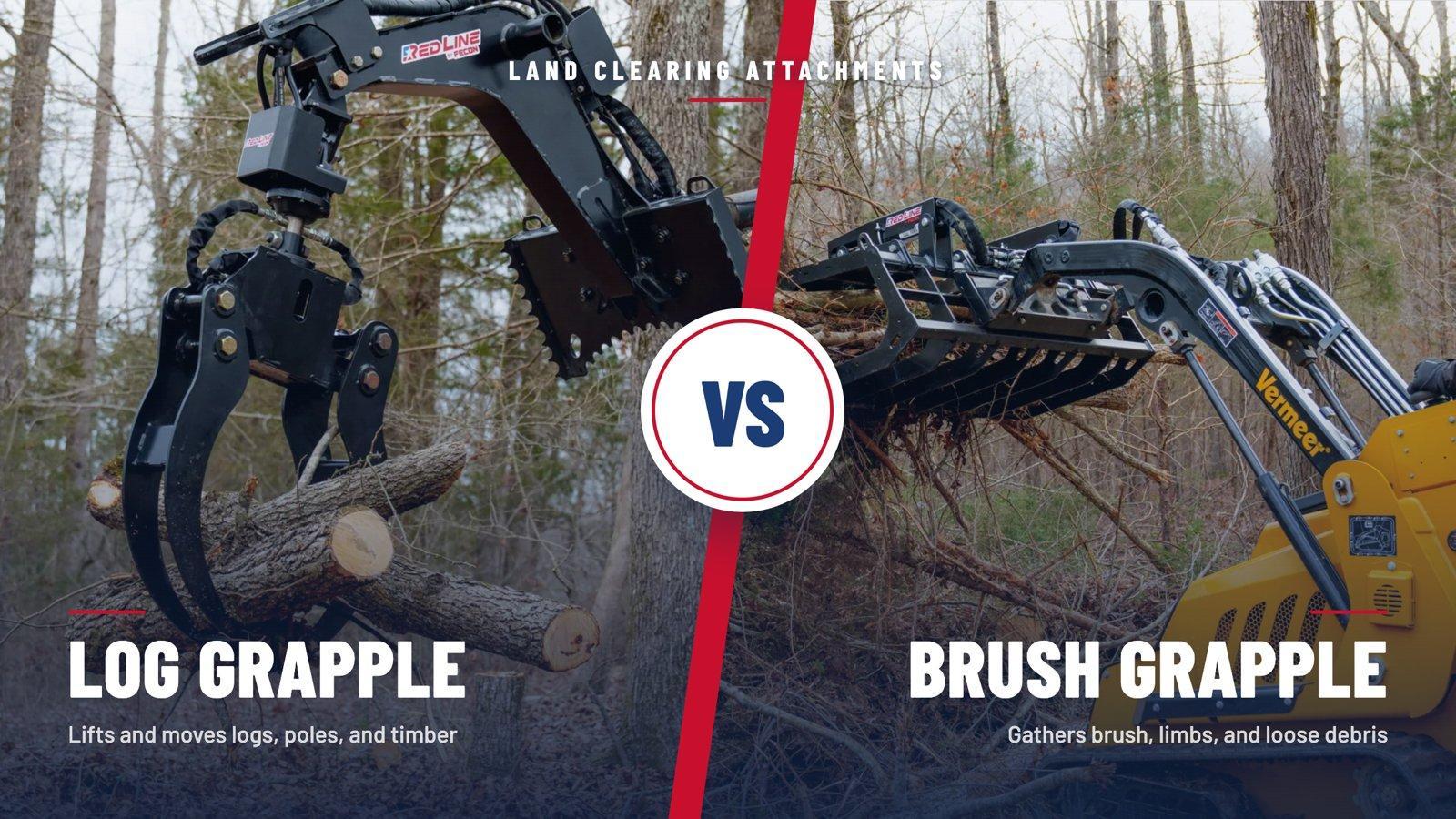
A brush grapple bolts solid to the quick attach and works like an open-bottom bucket with clamping lids. A log grapple like the Red Line LG57 hangs below the quick attach on a rotator, and its jaws close around wood from above. Nearly every practical difference between the two comes from that one design choice.
Both will pick up logs. The real question is whether your crew spends its hours on loose piles or on round wood that has to go somewhere specific.
What a Brush Grapple Does That a Log Grapple Can’t
Because it’s fixed to the machine, a brush grapple works like a bucket. You can rake debris together, push a pile up, scoop logs off the ground and stack a burn pile higher than a bucket could dump. The flat bottom skims the ground instead of digging in, so you can raise the boom slightly and curl back to roll brush and logs up into it.
The open tines let dirt and rocks fall through. That keeps weight down, and it matters at the chipper, because anything a solid grapple bucket scoops up ends up going through the knives.
Red Line brush grapples use two independent lids, so each side clamps down on its own part of an uneven load. A pile with a thick limb on one side and loose brush on the other stays locked in. Two lids also clamp a log evenly, which means you can grab a log at the base and hold it straight out at working height to limb it or cut it into sections without it rolling.
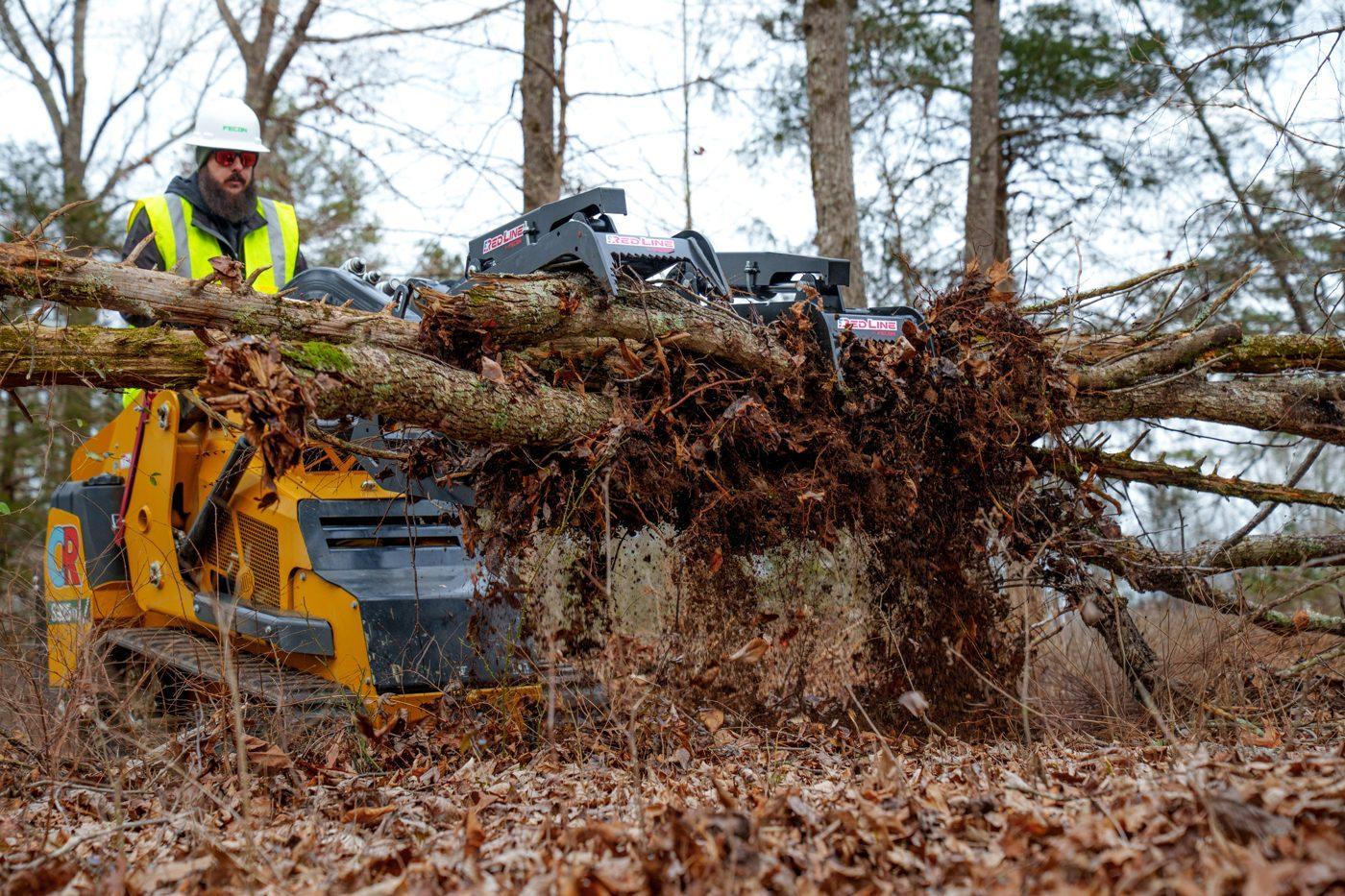 The Red Line 84-inch open-tine brush grapple for full-size skid steers carries a lot of volume per trip, and its lids open 60 inches for bulky material. Width has a cost, though. A wide grapple fills fast on a big pile but makes it harder to pick up a single limb, and it should be close to the width of your machine so you’re not driving over brush with the tires.
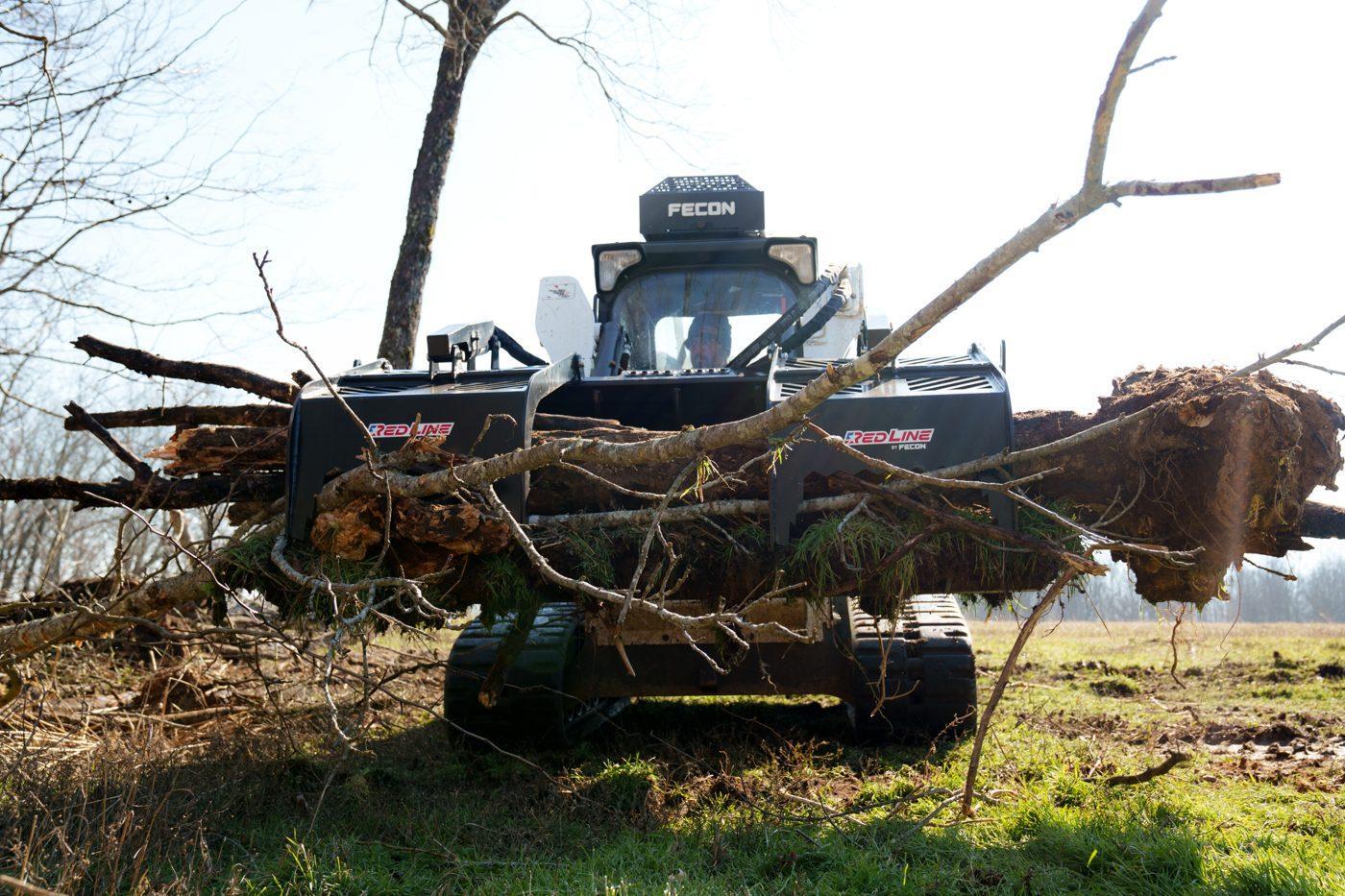 What a brush grapple can’t do is turn. It follows the angle of the loader, so placing a log means lining the whole machine up with the trailer or stack.
What a Log Grapple Does That a Brush Grapple Can’t
A hanging log grapple picks from above. You can grab a log at its balance point, or by one end and drag it to a landing. It rotates to set a log down square on a trailer or stack without repositioning the machine, and it can lift a log completely clear of the ground, which matters on a residential lawn you’re trying not to tear up. It also feeds a chipper well, since you can swing the butt end straight into the infeed.
On a mini skid steer, the rotating log grapple with rope bollards and a push bar for mini skid steers is set up for tree work. Its tined cradle holds logs both vertically and horizontally. The rope bollards let the machine act as the anchor for a rigging line, and the push bar helps steer a stem as it comes down. It doesn’t replace the ground crew, but it puts the machine’s weight on the rope instead of a person’s. A tow hitch receiver lets you move a trailer or chipper around the site without swapping attachments.
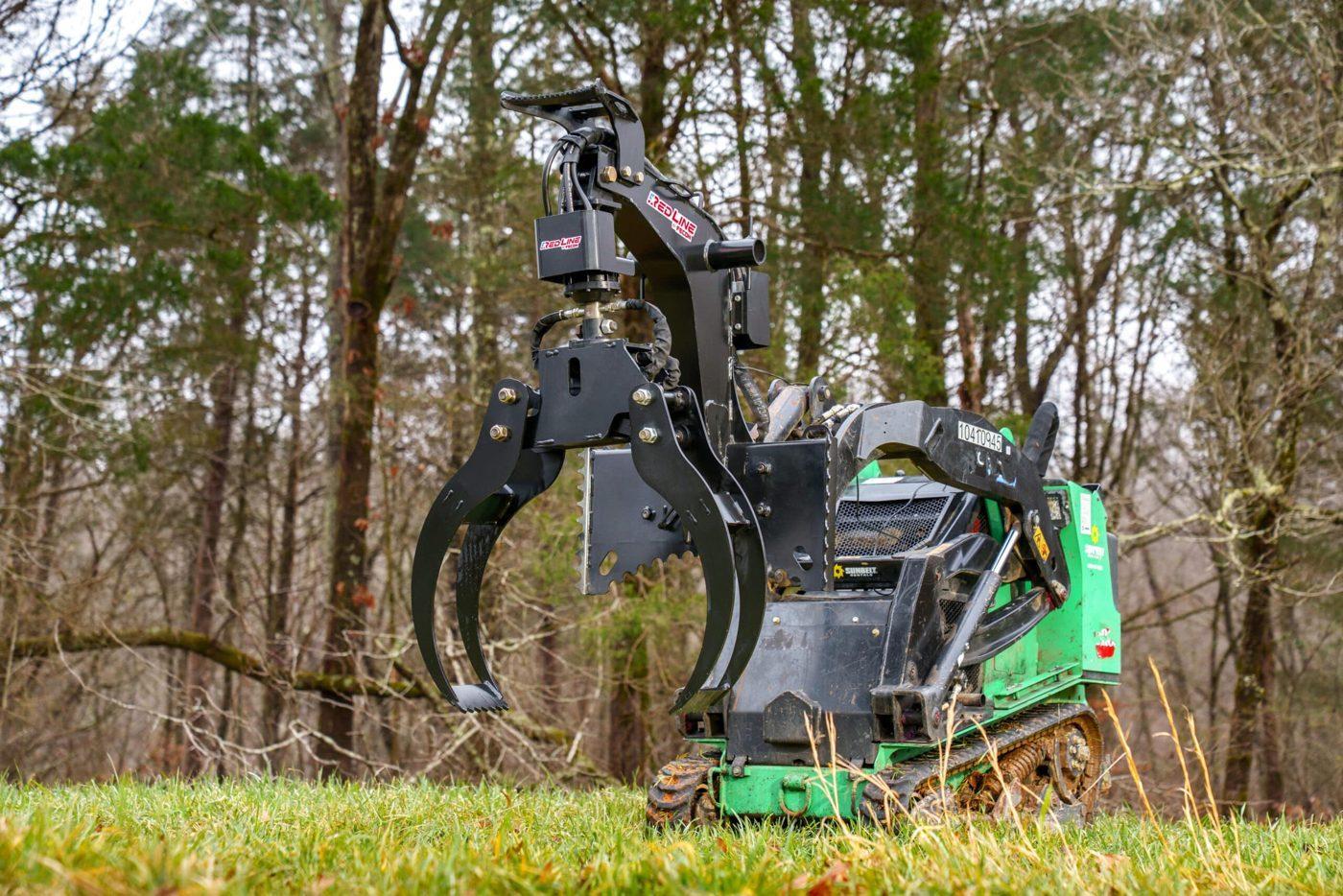 For full-size machines, Fecon’s 360-degree rotating log grapple for full-size skid steers has a 60-inch opening and heavily serrated plates that hold logs parallel or perpendicular to the loader. It comes in a light duty version at 940 lbs and a heavy duty version at 1,070 lbs, and the heavy duty is also built in a Bobcat configuration.
The trade-offs run the other way. A hanging grapple can’t push or rake, so it won’t build a pile. Its jaws are shaped for round wood, so loose brush and short limbs take more trips. And because the load hangs further out in front of the machine, it cuts into your usable lift capacity by more than the grapple’s weight alone.
Do You Need Powered Rotation?
Operators argue about this, and both sides have a point. On a stand-on mini skid steer, stepping off to reposition takes seconds and the machine is nimble enough to line up most picks, so plenty of tree crews run free-swing and never miss powered rotation. On a sit-in skid steer, climbing out of the cab is a bigger deal, and powered rotation earns its keep.
Free-swing lets the grapple turn as the load settles. It’s lighter and runs on a single auxiliary circuit. Powered rotation needs a second hydraulic function. On a machine with one auxiliary circuit, that usually means an electric-over-hydraulic diverter with a wiring harness and a switch in the cab, so check your machine before you order. The LG57 comes with free-swing standard and offers hydraulic or electric-over-hydraulic rotation.
Side by Side
| Key Features | Brush Grapple | Log Grapple |
|---|---|---|
| Mounting | Fixed to the quick attach | Rotates 360 degrees |
| Built to carry | Loose, uneven piles of brush and debris | Round wood you need to place |
| Pushes and rakes | Yes | No |
| Hydraulics | One auxiliary circuit | One circuit for free-swing, a second function for powered rotation |
| Mini skid steer | Red Line BG48: 48 in wide, 350 lbs | Red Line LG57: 57 in opening, 375 lbs |
| Full-size skid steer | Red Line BG84: 84 in wide, lids open 60 in, 990 lbs | Fecon FFG60: 60 in opening, 940 to 1,070 lbs |
| Best fit | Storm cleanup and right-of-way brush | Tree removal and log loading |
Picking by the Job
Storm Cleanup
Brush grapple for most crews. After an ice storm or a wind event, what’s on the ground is a tangle of limbs with some trunk sections mixed in. Width and the split lids clear it in fewer trips, and the open tines keep dirt out of the chipper.
Right-of-Way and Utility Clearing
Brush grapple for the cut material. A log grapple earns its place when crews handle larger stems that have to be stacked for pickup or left for the property owner.
Tree Removal
Log grapple. On a residential lot, an LG57 on a mini skid steer carries wood off the lawn instead of dragging it and feeds the chipper butt first.
Firewood and Log Yards
Log grapple. Every load is round wood that has to be placed, and rotation saves a repositioning move on each one.
Land Clearing
Brush grapple. It pushes material into piles and stacks them high for burning or hauling. If the timber is worth saving as logs, add a log grapple to sort and load it.
Mini or Full-Size
Match the grapple to the machine first. For mini skid steers, the 48-inch brush grapple sized for mini skid steers weighs 350 lbs and the LG57 weighs 375 lbs. The BG84 and the FFG60 are for full-size skid steers and compact track loaders.
Access decides a lot of this. A mini that fits through a backyard gate can carry wood straight to the truck. A full-size machine that can’t get through means dragging everything to the fence line first.
Then check the grapple’s weight against your loader’s rated operating capacity. Every pound of attachment comes out of what you can lift, and a hanging grapple takes more than its weight because the load sits further out. Send us your make and model and we’ll confirm the fit.
Handling Logs Safely
Lifting logs high in a brush grapple is where people get hurt. If the lids aren’t clamped tight, a log can roll back down the arms toward the cab. A log grapple holds the log from both sides, which is part of why crews moving a lot of round wood switch to one. Either way, keep loads low while you travel, and don’t handle logs overhead without falling object protection (FOPS) and a forestry door on the machine.
Crews That Run Both
Plenty of municipal and utility fleets end up with both, because storm season and scheduled tree work are different jobs. A log grapple with powered rotation usually costs more than a brush grapple of the same size, so if you have to buy one first, buy for the work that fills most of your hours. A brush grapple that handles the occasional log is the better first buy for a cleanup crew. A log grapple is the better first buy for a tree crew.
If the trees are still standing, the felling saw that cuts and holds a standing tree comes before either grapple.
Frequently Asked Questions
Q1. Can a brush grapple pick up logs?
Q2. Can a log grapple move brush?
Q3. Which grapple is better for feeding a chipper?
Q4. What’s the difference between a brush grapple and a root grapple?
Q5. What’s the difference between a brush grapple and a grapple bucket?
Getting the Right One
If the material is a loose pile you need to push together and haul, start with a brush grapple. If it’s round wood you need to place and load, start with a log grapple. Both brush grapples and the LG57 are part of the Red Line attachment line, backed by Fecon’s 12-month, 1,000-hour warranty. Send us your carrier make and model and we’ll confirm the fit before you order.