As a farmer, maximizing the use of your land is crucial for productivity and profitability. One often-overlooked way to add usable acres is fence row clearing: pushing back the fence rows and fence lines that brush, briars and volunteer trees have crept over year after year. These strips are usually left uncultivated for access or boundary reasons, but once they grow wide they cost you acres, shade the outside rows and catch on equipment. In this guide, we explain how to clear a fence line after harvest, which fence row clearing equipment fits the machine you already own, and how to keep the ground you win back.
What Is Fence Row Clearing?
A fence row is the strip of ground on either side of a field fence. A fence line is the fence itself and the path it follows, so you will hear both terms used for the same job. Fence row clearing, also called fence line clearing, means cutting, mulching or removing the brush, saplings and trees that have grown up in that strip, so the field can be farmed right up to the edge again.
Pushing back a fence row does not move your property line. The boundary stays where your deed and survey put it. What changes is how much of the ground on your side of it you can plant, graze or drive.
Why Expanding Farm Ground After Harvest Makes Sense
So, why do we recommend post-harvest maintenance? There are several benefits:
- Increased Usable Land: When you clear fence rows of overgrown vegetation and invasive species, you effectively expand your farmable area. In today’s competitive agricultural market, every acre counts.
- Improved Efficiency: Eliminating excess growth reduces the risk of pest infestations and diseases, which can thrive in overgrown areas, and ensures your crops grow in a healthier environment.
- Reduced Disruptions: It’s best to prioritize land improvements during the off-season since you won’t have to worry about regular operations. Schedule fence row clearing for when your equipment is not in heavy use to streamline your farming efforts.
How Much Ground an Overgrown Fence Row Costs You
The math adds up faster than most people expect. Every mile of fence that has grown out 15 feet into the field takes about 1.8 acres out of production. On a square 160-acre field, 15 feet of brush around the whole perimeter is roughly 3.6 acres, more than 2 percent of the field.
| Width of the overgrown strip | Acres lost per mile of fence |
|---|---|
| 10 feet | 1.2 acres |
| 15 feet | 1.8 acres |
| 20 feet | 2.4 acres |
| 30 feet | 3.6 acres |
Trees in the fence row also pull down yield next to them through shade and competition for water. In a 2020 Indiana Prairie Farmer and Purdue University corn trial, the first six rows beside a pine windbreak yielded 36 percent less than the rows further in. In an Indiana soybean field tracked in 2021, the first 45-foot pass along a tree line yielded about half of the field average. Edge effects vary with the field, crop, soil and weather, so treat these as examples rather than a rule, but they show why the outside rows are often the weakest part of a yield map.
The Best Time to Clear Fence Rows: Post-Harvest
When it comes to land maintenance, timing is everything. We recommend clearing fence rows post-harvest for several reasons:
- Equipment Downtime: Many farmers have a natural lull in their schedule after harvest. With less pressure to plant, you can dedicate time and resources to clearing overgrown areas.
- Ease of Clearing: In fall, we often see less dense vegetation, as many plants are dead or dormant. This simplifies removing brush and trees, allowing for a more efficient clearing process.
- Firmer Ground: From late fall into winter, the leaves are down and the ground is often firmer, so you can see what you are cutting and your machine leaves fewer ruts along the field edge.
If you plan to clear in spring or early summer instead, check your state’s guidance on bird nesting season first.
Fence Row Clearing Methods Compared
There is more than one way to clear a fence line. Each method leaves the ground in a different state, so pick the one that matches what you want the strip to become.
| Method | Best for | What it leaves behind | Watch out for |
|---|---|---|---|
| Chainsaw and hand tools | Short runs and a few trees | Brush piles to haul or burn | Slow and labor heavy on long fence lines |
| Dozer or excavator push-out | Taking trees and roots out to farm the strip | Windrows and disturbed soil | Soil loss, rocks pushed up, piles to burn, damaged fences |
| Rotary brush cutter | Brush and saplings up to about 4 to 6 inches | Cut material lying on the ground | Larger stems and trees need another tool |
| Forestry mulcher | Brush and small trees in one pass | A mulch layer that helps hold soil | Stumps stay in the ground and resprouts need follow-up |
| Herbicide | Keeping regrowth down after clearing | Standing dead stems | Label timing and rates, drift onto crops, state rules |
For most farms, the fastest route is forestry mulching or a brush cutter for the first pass, a stump grinder where the strip will be tilled, and a targeted follow-up on resprouts the next season.
Fence Row Clearing Equipment for the Machine You Already Own
You do not need a dedicated machine to start. The right fence row clearing equipment depends on what you already run and the size of the stems you hit most often.
Tractors
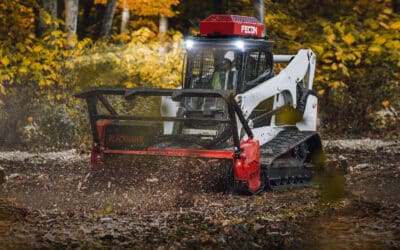
If you run a tractor between 45 and 110 horsepower, the PTO Bull Hog mounts on the three-point hitch and mulches brush and small trees along crop perimeters and fence rows. It comes in 60 and 73 inch working widths (RK6013P, RK6015P and RK7316P).
Skid Steers and Compact Track Loaders
The standard flow Bull Hog (RK5015 and RK6015) runs on 17 to 34 GPM and mulches trees up to 5 inches. If your loader has high flow hydraulics (30 to 50 GPM), a high flow Bull Hog mulching head handles standing trees in the 4 to 6 inch range. For lighter brush and saplings, the Red Line skid steer brush cutter (BC60 and BC74) cuts material up to 6 inches on 10 to 50 GPM, and the mini skid steer brush cutter (BC44) handles growth up to 4 inches.
Excavators
An excavator mulching head reaches across ditches, down banks and over a fence you want to keep. The CEM36 for 8 to 15 ton excavators mulches material up to 6 inches, and Fecon builds heads for smaller and larger excavators as well.
Tools That Finish the Job
Trees bigger than your mulcher’s rating come down first with a skid steer felling saw, which fells trees up to 14 inches per pass. A skid steer brush grapple pulls downed limbs, logs and old wire out of the row. Where you will till right to the fence, grind the stumps out with a stump grinder such as the Stumper by Fecon. Overhanging limbs up to 26 feet up can be trimmed from the cab with the Trim Ex tree saw.
Not sure which fits your operation? For bigger farm land clearing jobs, compare the agricultural attachments for fence rows and field edges, or read our guide on how to choose the right forestry mulcher. If the ground is grazing land rather than cropland, see reclaiming overgrown pasture.
How to Clear a Fence Line, Step by Step
- Walk the line and confirm the boundary. Find the survey pins or corner markers, and talk to your neighbor before you clear a shared fence row. Many states have line fence laws. In Ohio, for example, owners must keep a four-foot strip along a partition fence clear of brush and noxious weeds once the neighbor asks, and they have ten days to do it.
- Decide what happens to the fence. If the fence stays, work along it and keep the head off the wire and posts. If it is coming out, pull the old wire and posts first. Loose wire can wrap around a rotor or blade and stop the job.
- Mark the hazards. Flag rocks, old posts, buried metal, wells and drainage tile outlets. If you plan to grind stumps below grade or dig, call 811 first to have buried utilities marked.
- Take down the big trees first. Fell anything larger than your mulcher’s rated size, then cut the logs for firewood or haul them out with a grapple.
- Mulch or cut the strip. Work along the fence line in overlapping passes and keep the head or deck at the height your operator’s manual recommends.
- Deal with the stumps. Leave them flush if the strip will be grass or a field road. Grind them out if you will till or plant right up to the fence.
- Clean up. Pull limbs, wire and debris out of the row before the next planting so nothing ends up in the combine.
- Plan the follow-up. Mark your calendar for resprouts in the next growing season.
How to Safely Push Back Fence Rows
When it comes to fence line clearing, a few safety steps matter most:
- Wear Protective Equipment: Always wear protective gear, including gloves, goggles, and hard hats, to minimize the risk of injury from debris or sharp tools.
- Maintain Safe Distances: Be aware of your surroundings, especially when working near power lines or roadways. Ensure a safe distance to prevent accidents.
- Choose the Right Tools: Select fence row clearing equipment that matches the size of what you are cutting. A mulcher or brush cutter keeps the operator in the cab and away from the cutting zone.
- Pull Old Wire First: Remove loose barbed wire, woven wire and T-posts before you start, or flag them clearly if the fence is staying.
- Keep People Back: Mulchers and brush cutters can throw debris. Keep bystanders, livestock and vehicles outside the safety zone listed in your attachment’s operator manual.
How to Keep Fence Rows Clear After the First Pass
Clearing is the first step, not the last. Many fence row species, such as multiflora rose, black locust, bush honeysuckle and autumn olive, resprout from the stump or the roots. Purdue Extension notes that mowing alone often triggers vigorous resprouting from the root system and should be paired with another treatment, such as herbicide. Our invasive species removal guide covers follow-up treatment in more detail.
- Make a second pass: A lighter pass the following season knocks back resprouts while they are still small.
- Follow the label: If you use herbicide, follow the product label for timing and rates. Some labels require a waiting period after mowing before you spray, and many woody-plant treatments work best in late summer.
- Keep a cycle: A quick pass every year or two with a brush cutter or mulcher costs far less than reclaiming a fence row that has grown back into trees.
Fecon Bull Hog: The Perfect Tool for Clearing Fence Rows
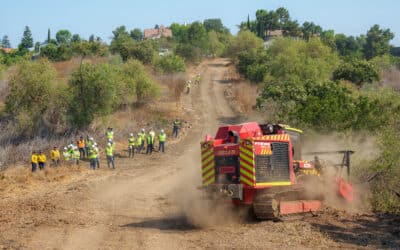
The Fecon Bull Hog mulcher is an exceptional choice for fence row and fence line clearing. Here’s why:
- Power and Efficiency: The Bull Hog’s robust build can quickly handle heavy vegetation and thick brush, cutting time and labor costs. For lighter regrowth along fence rows you have already cleared, a brush cutter for skid steers handles maintenance passes on brush and saplings up to 6 inches.
- Versatile Applications: From stubborn undergrowth to saplings and small trees, there is a Bull Hog for tractors, skid steers, excavators and purpose-built mulching tractors, so you can match the head to the material along your fence line.
- Improved Land Management: The Bull Hog leaves behind finely mulched material, eventually decomposing and enriching the soil.
Maximizing Land With Fecon Equipment
Investing in the right equipment is key to maximizing your farm’s productivity. Think of fence row clearing as a long-term investment in your land’s potential.
- Consistent Maintenance: Fecon’s mulchers, stump grinders, and forestry attachments can help you maintain clean and productive land year after year.
- Increased Productivity: Increase your crop yields and overall farm productivity by prioritizing your land’s usability. Investing in efficient equipment will allow you to focus on what truly matters: cultivating healthy, abundant harvests.
By utilizing powerful tools like the Fecon Bull Hog and committing to regular maintenance, you can reclaim valuable space, improve efficiency, and invest in the long-term success of your farm. Have questions? We’re always here to help. Reach out to our team anytime, or find a Fecon dealer near you. For every attachment we build for fence rows, field edges and overgrown ground, see our farm attachments.